


The short version:
For a decade, growth meant headcount. AI is breaking that link: leverage per operator is becoming the real metric.
A lot of venture capital never financed product — it financed coordination. That’s the layer AI compresses first.
Lean doesn’t mean cheaper, and it doesn’t mean fewer good people. It means different people, and a cost structure that moves from organizational complexity to infrastructure complexity.
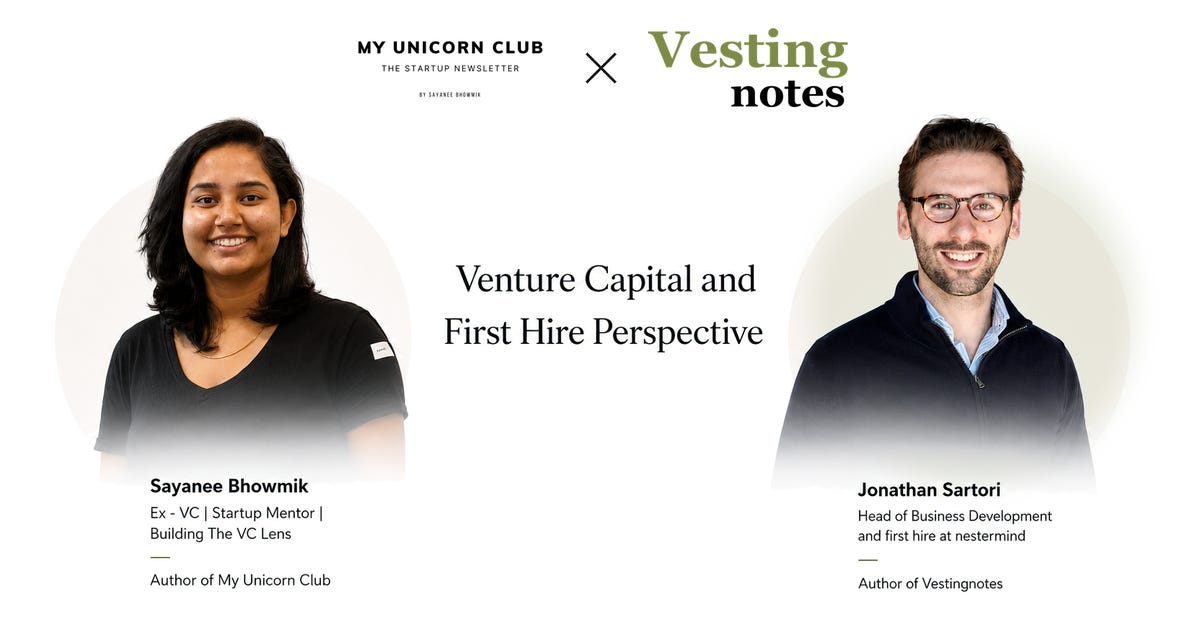
From the investor’s seat (Sayanee Bhowmik): capital shifts from “burn optimization” to “timeline optimization,” rounds concentrate, and the power law refuses to die.
Part One — The View From Inside the Company
Lately I’ve been thinking a lot about AI — but not through the usual “AI is replacing jobs” lens.
The more interesting shift, from where I sit inside an early-stage startup, is happening somewhere else entirely: inside the structure of startups themselves. And, as a consequence, inside venture capital too. Because if AI changes how companies are built operationally, it inevitably changes how they get funded, how teams scale, and how ownership evolves over time.
For a decade, scaling a startup meant hiring
For the last ten years, scaling followed a predictable formula: raise capital → hire people → increase execution capacity. More engineers, more SDRs, more ops, more support, more management layers. Growth and headcount were inseparable, because execution itself required coordination at every level of the organization. As startups grew, complexity grew alongside them — more meetings, more alignment, more reporting, more overhead.
That’s exactly where AI quietly starts to get interesting.
AI doesn’t replace operators. It increases leverage per operator
Today one strong operator can execute across research, documentation, workflow automation, market analysis, customer support, internal reporting, prototyping — and increasingly engineering. Not perfectly, not autonomously, but well enough that the amount of organizational structure required to reach real traction is starting to change.
This isn’t theoretical. Sequoia has pointed to AI-native startups generating more than $1M in revenue per employee while building “self-improving companies” that use AI internally across legal, recruiting, sales, and operations. Historically, startups burned capital early because scaling execution meant scaling headcount — people for ops, support, onboarding, implementation, reporting, coordination. AI-native companies are beginning to compress many of those layers at once, and that changes the economics of building from the ground up.
Lean doesn’t mean fewer good people. It means different people
AI-native startups increasingly operate like infrastructure companies internally. The goal is no longer only building the product — it’s building the systems that multiply execution capacity across the whole company. Less coordination for its own sake, more systems thinking. Less manual workflow management, more orchestration. Less middle management, more technical infrastructure.
That raises the bar for early operators rather than lowering it: exceptional engineers, workflow architects, and infrastructure-minded builders who can operate in ambiguity.
Lean doesn’t mean cheap, either
AI reduces organizational complexity but adds technical complexity. Inference, compute, orchestration, evaluation systems, data infrastructure, automation reliability — these are becoming core operational layers. And unlike traditional SaaS, many AI products carry variable costs that scale directly with usage. The cost structure shifts; it doesn’t disappear.
So early-stage startups now have to scale two things at once: organizational scalability and infrastructure scalability. Increasingly, the second one matters more.
The human layer still compounds
Startups may become simultaneously smaller in headcount and more powerful in execution. But the qualities that compound most in zero-to-one are still deeply human: judgment, trust, adaptability, conviction, ownership mindset, and the ability to keep executing when momentum temporarily disappears. AI accelerates execution. It doesn’t replace the decisions you make with incomplete information.
So maybe the real shift is this: the next generation of winners won’t be defined by who hires fastest, but by who creates the most leverage per operator. AI may not remove the operator journey — it may simply make the best operators more visible.
That’s the change I feel from inside the company. But the more I sit with it, the more I suspect the bigger earthquake is on the other side of the table — in how this capital efficiency reshapes the people writing the checks.
So I asked someone who’s sat there.
Part Two — The View From the Other Side of the Table
by Sayanee Bhowmik (Thank you for the collab 🚀😊)—My Unicorn Club - The Startup Newsletter
Venture capital was built around an assumption: that growth requires proportional organizational expansion. More growth → more hiring → more burn → more fundraising. If AI lets a startup hit Series A metrics with a third of the team, that chain starts to break. So the real question for investors is: what changes when capital no longer mainly buys time to hire and coordinate?
What is venture capital actually for now? If coordination is partly automated, what does an AI-native founder actually spend a round on?
Capital has always been a tool for growth — expanding market share, increasing revenue, and ultimately improving profitability. The expectation is straightforward: capital drives outcomes, outcomes drive valuation, and investors generate returns.
Historically, a significant part of venture underwriting focused on capital efficiency: how much money a company needed to achieve a given milestone. Metrics such as cash burn and runway were central to fundraising discussions.
AI is changing that equation. As software development, operations, and decision-making become more efficient, every dollar goes further. The conversation is shifting away from burn optimization toward speed of execution. Today, capital is increasingly being deployed not to reduce costs, but to help companies accomplish more in less time. In many cases, time — not cash burn — has become the primary constraint.
Round sizes and cadence: do “seed” and “Series A” still mean the same thing? If founders can go further before raising, are we heading toward smaller, later, or fewer rounds?
What we’ve observed throughout 2025 is a much stronger concentration of capital. Venture capital has always followed a power-law distribution, where a small number of companies generate the majority of returns. But the funding landscape is becoming even more concentrated.
Rather than a broad “spray and pray” approach, investors are increasingly deploying larger checks into a smaller set of conviction-backed companies, often at earlier stages. At the same time, angels, syndicates, and family offices have become significantly more active, filling much of the financing gap at the pre-seed and seed stages.
As a result, traditional early-stage VC participation has evolved. Many institutional funds are entering later or concentrating their capital into fewer opportunities, while smaller early-stage rounds are increasingly being serviced by alternative sources of capital.
Ownership and dilution: who blinks? Capital-efficient founders stay concentrated longer — does that collide with funds that need ownership targets to make the math work?
Neither side necessarily has to blink.
The venture ecosystem is adapting to a new reality in which founders can build meaningful businesses with less upfront capital. As a result, investor expectations around ownership are evolving as well. While ownership targets remain important, they are no longer the sole determinant of whether a fund participates in a company.
Strong businesses will continue to command favorable terms, and investors are increasingly willing to be flexible when they believe the opportunity justifies it.
The fund-math problem: how do large funds deploy? VC returns depend on owning enough of the winners. If the best companies need less money, how do large funds put capital to work?
While AI companies often appear capital-efficient in their early stages, the economics change as they scale.
Many AI businesses are built on usage-based infrastructure (pay per use), where compute costs increase alongside customer growth. As a result, the amount of capital required to launch a company may be lower than ever, but the capital required to scale it can still be substantial.
This may lead to a shift in capital allocation across the venture lifecycle. Rather than large amounts of money being deployed at inception, we could see more capital concentrated in later-stage rounds, where companies need financing to support infrastructure, compute, and growth at scale.
What do investors diligence differently? When five people hit $1M per employee, how do you separate durable leverage from a thin wrapper any incumbent can copy?
This remains one of the biggest challenges for investors today, and I don’t think the industry has fully solved it yet.
There is still a meaningful knowledge gap on the investment side when it comes to evaluating AI-native businesses and understanding the depth of their technical differentiation. Many investors are learning in real time.
Over the next few years, I expect this gap to narrow as more operators, engineers, and technical founders move into investing. People who have built and worked with these technologies firsthand will be better positioned to assess what constitutes a defensible advantage versus a superficial layer that can be replicated.
Until then, the industry is still in a learning phase.
The contrarian take: does AI reshape startups more than VC? Maybe money still flows the same way and power laws still rule. Where do you actually land?
I largely agree with that view.
Venture capital, at its core, is still a branch of finance. While data, models, and frameworks matter, investing has always involved a degree of judgment, intuition, and conviction about the future.
AI will undoubtedly change how startups are built and how investors evaluate opportunities. Venture firms will continue updating their theses and adapting to new market realities. But the fundamental objective remains unchanged: identifying exceptional companies and generating outsized returns.
I also don’t believe AI fundamentally breaks the power-law nature of venture capital. The starting line may be more accessible today — founders can build faster and with fewer resources — but the finish line remains just as competitive. The distribution of outcomes is still likely to be heavily concentrated among a small number of winners, which means the underlying dynamics of venture returns may prove more resilient than many expect.
Closing — Two Takes, One Question
From inside the company, the shift looks like leverage per operator: smaller teams, bigger output, ownership over coordination.
From the investor’s seat, VCs will evolve. The conversation moves from “cash burn optimization” to “timeline optimization.” Traditional institutional seed doesn’t disappear — it gives way to angels, syndicates, and family offices, while bigger checks concentrate later. And the power law keeps doing what it does.
Either way, the decade ahead may reward concentration — of ownership, of leverage, of conviction — more than scale for its own sake.
Frequently Asked Questions (FAQs)
Does AI reduce the capital a startup needs to raise?
It reduces the capital needed to start. AI compresses many of the early operational layers — ops, support, onboarding, reporting, coordination — that startups used to fund with headcount. But scaling can still be capital-intensive, because usage-based infrastructure and compute costs grow with the customer base. The amount needed at inception falls; the amount needed to scale often doesn’t.
What is an AI-native startup?
An AI-native startup builds AI into both its product and its internal operations from day one, rather than bolting it on later. Internally it behaves more like an infrastructure company: it invests in systems and orchestration that multiply execution capacity across the whole team, instead of adding headcount for every new function.
Will AI replace venture capital?
No. Venture capital is, at its core, a branch of finance built on judgment, conviction, and the power law — a few winners returning the fund. AI changes how startups are built and how investors run diligence, but it doesn’t change the underlying objective: finding exceptional companies and generating outsized returns.
Why is venture funding becoming more concentrated?
Because capital efficiency lets a smaller set of companies show strong metrics earlier, investors are deploying larger checks into fewer, higher-conviction bets. Angels, syndicates, and family offices increasingly fill the pre-seed and seed gap, while institutional funds enter later or concentrate capital where conviction is highest.
What does “leverage per operator” mean?
It’s the output a single strong operator can produce when AI handles research, documentation, automation, analysis, support, and prototyping. The thesis: the next generation of winners won’t be defined by who hires fastest, but by who creates the most leverage per person.
Are AI startups cheaper to build but more expensive to scale?
Often, yes. AI reduces organizational complexity but adds technical complexity — inference, compute, orchestration, evaluation, data infrastructure. Many AI products carry variable costs that rise directly with usage, so the cost structure shifts toward infrastructure rather than disappearing.
What is the power law in venture capital?
The power law is the pattern where a small number of investments generate the vast majority of a fund’s returns. AI may make the starting line more accessible, but the finish line stays competitive — so outcomes are still expected to concentrate among a few big winners.
A few things you might have missed on Vestingnotes:


See you next week 🕶️
… and don’t forget to follow us on LinkedIn Jona & Sayanee 😎
Cheers,
Jona & Sayanee
