
The Self-Storage Opportunity: The $60B Market Most People Overlook
A quiet industry at the intersection of real estate, logistics, and modern urban life

The Self-Storage Opportunity: The $60B Market Most People Overlook
The self-storage industry rarely makes headlines.
It’s not AI. It’s not crypto. It’s not venture-hyped software, or Gold.
The global self-storage market is not emerging — it is already structurally large. In 2024, global revenues sit at approximately USD 60–61 billion, with projections reaching USD 107–109 billion by 2034, implying an annual growth rate of roughly 5.9–6.1% CAGR. North America currently represents just under half of global revenues (~48%), reflecting maturity and consolidation (Precedence research, 2025).
Europe alone accounts for an estimated USD 13.7–27.4 billion in 2024–25, depending on methodology, with projections ranging between USD 19 billion and USD 35+ billion by 2030–2034, growing at approximately 2.9–6% CAGR. Institutionalisation is increasing, particularly in urban and e-commerce-driven markets (Imarc Group, 2025)
Switzerland, often perceived as small, represents an estimated USD 10–10.6 billion market in 2024–25, with projections surpassing USD 13.5 billion by 2032–33, growing at around 3.8–4.2% annually, supported by urban density, high disposable income, SME activity, and digital commerce (Data Insights Market, 2025).
This is not a niche segment.
It is a multi-billion regional and global infrastructure market with recurring revenue characteristics, real asset backing, and steady mid-single-digit structural growth.
The interesting question is:
Why self-storage — and why now?
The Market Structure: Predictable Demand, Fragmented Supply
Self-storage demand is not built on trend cycles or speculative behavior. It is anchored in structural demographic and economic shifts.
Urban densification continues to reduce average living space per capita. Apartment sizes shrink while consumption patterns expand. People accumulate possessions faster than they increase square meters. At the same time, SMEs and e-commerce operators require flexible inventory space without committing to long-term commercial leases.
The result is a persistent mismatch between owned goods and available space.
Self-storage demand is driven by:
Urban densification
Shrinking apartment sizes
SME storage needs
E-commerce overflow
Relocation and downsizing
Unlike volatile consumer categories, storage demand often proves resilient during economic downturns. Downsizing, relocation, restructuring, and life transitions tend to sustain or even increase occupancy levels. This resilience is precisely why institutional capital increasingly views self-storage as a defensive real estate asset class.
The Economics: Why the Model Is So Attractive
Self-storage economics revolve around two strategic models.
The first is asset-heavy. Operators own the underlying real estate, finance development or acquisition, and optimize long-term occupancy and yield per square meter. This model is capital intensive, slower to scale, but structurally powerful once stabilized. Ownership introduces margin expansion and real estate appreciation upside, making long-term equity value significantly more attractive.
The second model is asset-light. Operators lease warehouse space, optimize operations, and focus on speed of expansion with lower upfront capital exposure. This approach allows faster scaling but limits margin compression and real estate-driven upside.
The strategic tension lies between scaling and compounding.
Asset-light scales faster. Asset-heavy compounds harder.
The Friction Problem: Storage Solves Space, Not Time
Traditional self-storage models are operationally simple. Customers rent a unit, transport belongings, manage organization themselves, and retrieve items when necessary.
The model solves space constraints. It does not solve logistical friction.
In dense urban environments, the true constraint is often time, together with square meters. Customers must coordinate transportation, allocate half-days for drop-offs, and manage physical visits for retrieval.
This friction is where structural innovation becomes relevant.
If the customer no longer needs to physically interact with the facility, the economics and location strategy of storage change entirely.
The AnyWare Thesis: From Self-Storage to Managed Inventory
Before nestermind, I worked on an idea called AnyWare with a friend of mine, which attempted to rethink storage from first principles.
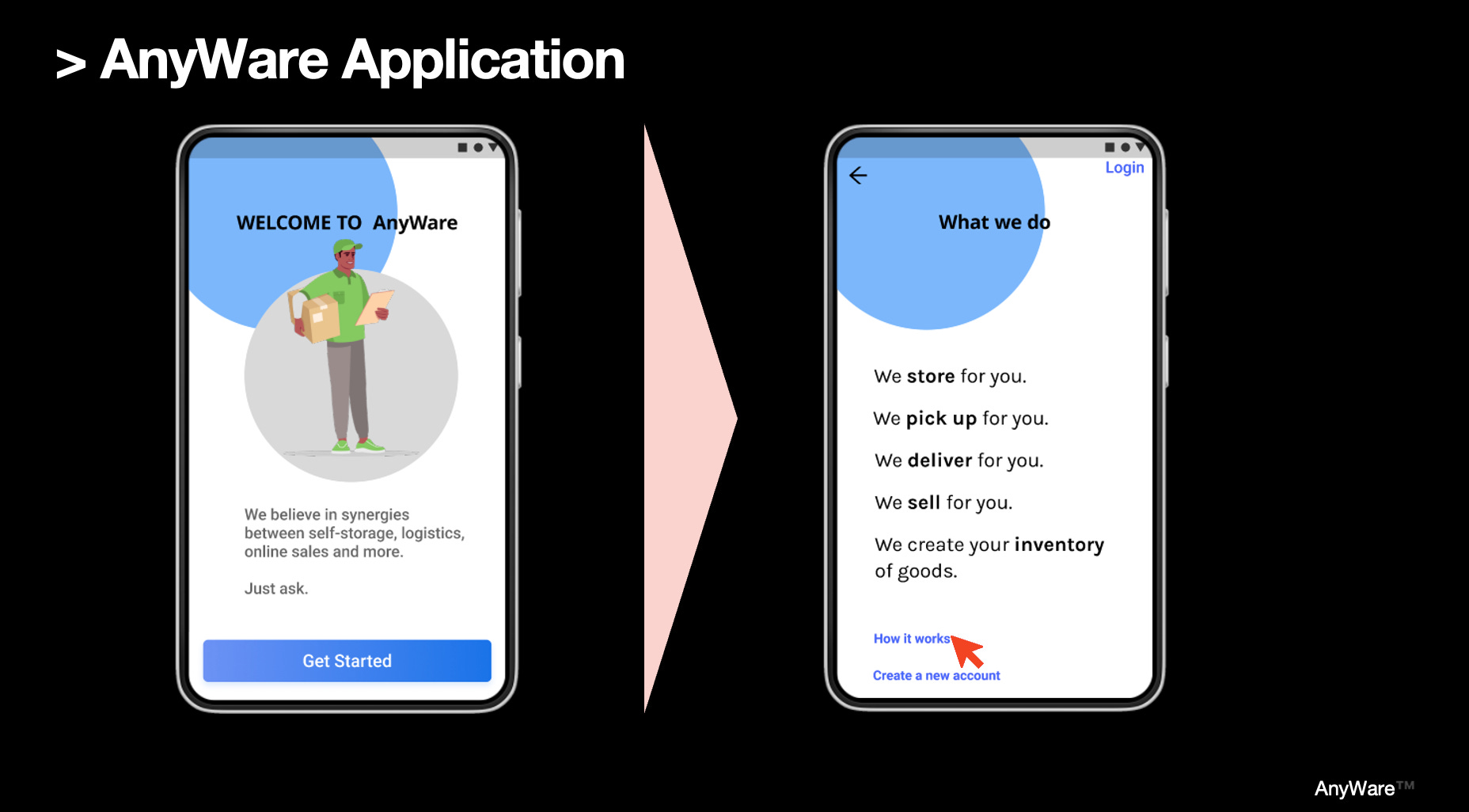
(Please don’t judge the aesthetics… it was a really, really early stage, and my Figma skills weren’t the best 😊).
The thesis was straightforward: people do not want a storage unit. They want the storage problem removed.
AnyWare proposed a logistics-integrated model built around:
Home pickup
Warehousing outside expensive city centers
Digital inventory management
On-demand item return
Subscription-based pricing
The structural insight was economic rather than technological.
Urban real estate is expensive. Peripheral warehouse space is significantly cheaper. If customers do not need direct access, facilities can be located outside high-rent zones, dramatically improving cost structures. Storage transitions from self-service space to managed inventory.
Basically the opposite of what PlaceB is doing in Switzerland (btw, they’re doing a great job!).
I never really moved forward with this idea, because nestermind came along and I couldn’t pass on that opportunity. Deep down, I also felt that before building something of my own, I still needed to gain a lot more experience.
That said, I’m genuinely happy that SaveSpace has emerged in Switzerland in the meantime. I follow them quite closely, both to see what they’re building and how they’re solving some of the challenges we had identified when analyzing the business models.
SaveSpace is doing something similar to Wetacoo in Italy (EUR 3.4 million Series A, led by VC Partners) — not bad at all! 👍
So why this and Why now?
One question still remains.
If the self-storage market is already a multi-billion industry with stable demand, predictable economics, and structural growth — why hasn’t a dominant digital layer emerged around it?
In real estate, aggregation platforms have become fundamental infrastructure. Self-storage, surprisingly, still behaves differently.
Across Europe, the market remains highly fragmented. Operators tend to manage their own inventory directly through their websites, relying heavily on local SEO, brand visibility, and geographic proximity. Customers typically search for storage in a specific city, discover a handful of providers, and interact with them individually.
The result is a market where discovery happens locally rather than through a unified digital interface.
A few companies have started experimenting with aggregation models. Storabble, for example, is attempting to build a platform that centralizes self-storage listings, bringing transparency and comparability to the market.
The idea makes intuitive sense.
But it also raises an interesting question for the next decade.
With the rise of AI-driven search, GEO-localized discovery, and increasingly sophisticated indexing systems, do self-storage listings actually need a traditional aggregator?
Unlike real estate transactions — which involve large financial decisions and long evaluation cycles — storage decisions are often fast, local, and highly granular. Users usually search within a small geographic radius and prioritize immediate availability rather than browsing dozens of alternatives.
If AI systems increasingly surface the most relevant storage providers directly — based on location, availability, and pricing — operators with strong digital infrastructure and search visibility may already possess the distribution layer they need.
In other words, the future discovery layer might not be a marketplace at all. It might be the interface through which people search. And if that is true, the real opportunity may not lie in aggregating storage units — but in redesigning the storage experience itself.
From physical space to managed inventory. From access to convenience. From square meters to logistics.
And that brings us back to the original question.
Why this — and why now?
Because the structural conditions are finally aligning: urban density continues to rise, living spaces keep shrinking, and small businesses increasingly operate with flexible inventory and storage needs. At the same time, digital infrastructure — from logistics to AI-powered search — is making it easier than ever to build new layers on top of physical assets.
The self-storage industry may look quiet from the outside. But underneath, it sits at the intersection of real estate, logistics, and digital discovery. And markets that sit at intersections are often the ones where the next wave of innovation quietly begins.
A few things you might have missed on Vestingnotes:
See you next week 🕶️
… and don’t forget to follow me on LinkedIn 😎
Cheers,
Jona
Interesting how a steady market like self-storage starts looking like infrastructure once you connect urban density, logistics, and digital discovery